TL;DR
Most companies spend heavily on their digital brand and treat branded merchandise like a logistics problem. That gap is costing them. The welcome kit, the client gift, the leave-behind. Inconsistent, forgettable, off-standard. Every merch touchpoint is either building trust or quietly eroding it. There is no neutral.
Taylor Swift has 8 AMA nominations this year.
Not because she got lucky. Not because she released one great album and hoped for the best. Because she shows up at full standard, every single time, across every single touchpoint. The music. The visuals. The tour. The merch. The cultural moment she manufactures every time she walks into a room.
There are no half-measures. No “good enough” releases. No off-brand moments where she just sort of shows up and hopes nobody notices.
That is the standard.
Now think about the last thing your company sent a new client.
The welcome kit. The onboarding packet. Did it hit the same standard as your pitch deck? Did it feel like it came from the same firm that charged what you charged and promised what you promised?
Or did it feel like something someone ordered in a hurry from a catalog?
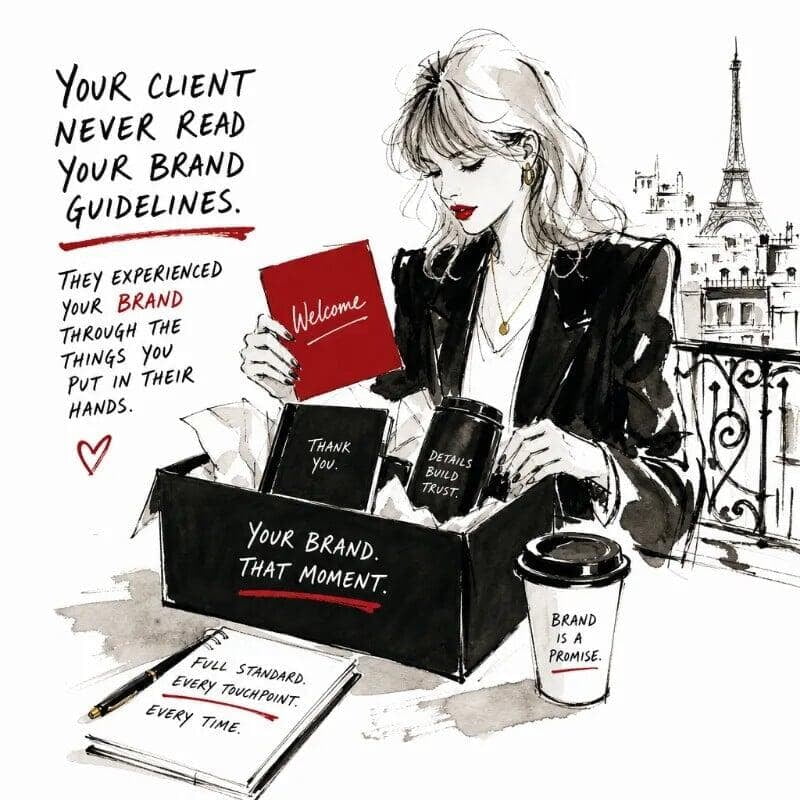
Your client never saw your brand guidelines. They never read your positioning statement. They did not study your website before the relationship started. They experienced your brand through the things you put in their hands. The pen. The notebook. The box that arrived at their office on day one.
That box is your brand in that moment. Nothing else is.
And if the box says “mass-produced” while your invoice says “premium,” you have a problem that no amount of great work will fix.
I have spent more than two decades in the branded merchandise industry, watching firms invest six figures in rebrands and then hand new clients a $4 pen and a folder they ordered from a big box store. The design team spent months on the logo. Someone spent 11 minutes on the welcome kit. The client experienced the welcome kit.
The Standard Gap: Why Most Companies Are Playing a Different Game Than They Think
Most marketing directors believe that “the important stuff is the digital stuff. The merch is just a nice touch.”
That belief is expensive.
It explains why firms that obsess over typefaces approve a welcome kit without a second look. It explains why the brand manager who would never let a misaligned social post go live signs off on a branded item that contradicts everything the brand stands for.
The digital brand got a strategy. The branded merch got a budget and a deadline.
Think about what that looks like from the client’s side. They receive a proposal that feels premium. Every detail signals quality, care, and intentionality. They say yes. Then the relationship begins, and the first tangible thing they receive is a kit that feels like it was assembled the day before it shipped. Generic items. Inconsistent colors. A box that communicates exactly nothing about who you are.
The pitch said one thing. The package said another.
This is Brand Friction. It’s the distance between the brand experience you intend and the brand experience you actually deliver. Most firms have more of it than they realize. Almost none of them know where it lives.
A law firm I know spent eight months and significant budget on a complete rebrand. New logo. New color palette. New brand voice. Beautiful work. Then they launched the rebrand at a client event and handed out branded merchandise that had been ordered before the rebrand was finished. Old logo. Old colors. Wrong font. Every item in the room contradicted the brand they had just announced.
The rebrand said: we are intentional, premium, and detail-oriented.
The merch said: we didn’t check.
That’s what brand friction does. It does not announce itself. It just sits there, in the hands of the people whose trust you are trying to build.
The firms that win long-term are the ones who treat every merch touchpoint the same way Taylor Swift treats every album cycle. Not as a logistics problem. As a brand moment that will either reinforce the relationship or quietly start eroding it.
The Full Standard Audit: Five Questions That Reveal Whether Your Brand Shows Up or Phones It In
Seth Godin wrote in This Is Marketing (2018): “Every interaction is an opportunity to make an impression.”
Branded merchandise expressions are the interactions most firms are wasting.
Not because they don’t care. Because no one has given them a framework for evaluating whether what they are sending is hitting the mark. They approved the logo. They matched the PMS number. They assumed the rest would follow.
It does not follow automatically. It has to be built.
1. The First Impression Test
What does a new client receive on day one, and does it match the standard of your pitch deck?
Pull out both right now. Put them side by side. The pitch deck probably has a cover page with your logo, your colors, your typography, your brand voice baked into every slide. Now look at the welcome kit. Does it feel like it came from the same firm? Does the quality of the materials match the quality of the promise?
If someone handed you both items with the name removed, would you know they came from the same brand?
If the answer is no, that is where the trust starts leaking. Day one.
2. The Shelf Life Question
Would a client keep this item six months from now, or does it end up in the trash?
This is the fastest metric for quality in the industry. Items that get kept are items that communicate value. Items that get thrown away communicate that the sender did not think about the recipient. They communicate volume thinking dressed up as generosity.
A $4 pen does not build a relationship. It fills a drawer until someone throws it away. The branded item that sits on a client’s desk for two years is doing more brand work than any digital ad you have ever run.
3. The Brand Blind Spot Check
Does your branded merch match your visual identity, or is it a different brand entirely?
This one is more common than anyone admits. A firm has a sophisticated, refined brand. Muted palette. Clean typography. Premium positioning. Then they order branded merchandise from a catalog, and the closest color match is “royal blue,” and the logo gets slapped on a poly-blend tote bag that costs three dollars.
Now the brand is two different brands depending on whether the client is looking at your website or holding your merch.
Run every branded item through your brand standards before it goes out. If it would fail a brand audit, it does not ship.
4. The Sender Signal
If this item arrived with no logo, would the recipient still know it came from a premium firm?
This is the hardest question on the list and the most important. The logo is the easy part. The quality of the item, the thoughtfulness of the selection, the way it was packaged and presented: those communicate before the logo does.
Great branded merchandise does not rely on the logo to do the work. The item itself signals who sent it. The logo just confirms it.
If your merch needs the logo to communicate premium, the item is not doing its job.
5. The Consistency Test
Does every touchpoint across every client interaction hit the same standard, or does quality depend on who ordered that week?
This is the Taylor Swift question. She doesn’t release a great album and then go quiet for five years and hope everyone remembers. She maintains the standard across every touchpoint, every cycle, every room she walks into.
Your brand needs to do the same thing. The welcome kit for the client who came in through a referral should hit the same standard as the one for the client your managing partner personally landed. The conference leave-behind should hit the same standard as the client appreciation gift. The holiday gift program should hit the same standard as the onboarding kit.
Consistency is not just a quality argument. It is a trust argument. Every time the standard slips, the client’s gut registers it. They may not say anything. The relationship may look fine. But trust is built in the moments where the standard held. And it erodes in the moments where someone decided “good enough” was close enough.
It never is.
The Crafted Takeaway
Your brand has a standard. The question is whether it travels.
A brand that shows up at full standard in the pitch and phones it in on the branded merchandise is not a premium brand. It’s a premium brand in the places no one checks, and an average brand in the places that matter most.
Full standard is not about spending more. It is about deciding that every item that leaves your building represents you, and holding that line every single time.
Where does your brand’s standard slip most, the welcome kit, the gifting program, or the conference materials?