
TL;DR: Digital marketing is drowning in its own abundance. Every brand is online. Every brand is optimizing. And yet, connection (the thing that actually drives pipeline) has never been harder to create through a screen. The brands winning right now are investing in something physical.
You’re in a marketing review. The slides are up. Someone walks through impressions, click-through rates, cost-per-acquisition, scroll depth. The data is clean. The charts trend upward. Everyone nods.
And somewhere in the back of your head, a quiet voice asks: Is any of this working?
Are we building something?
Are people actually connecting with this brand?
Is any of this making us memorable?
The answer, increasingly, is no.
The average person sees somewhere between 4,000 and 10,000 digital ads per day. The human brain has developed an immune response to all of it. We scroll. We skip. We block. We forget. We’ve gotten so good at ignoring digital content that the entire premise of “getting in front of your audience” has fundamentally broken down.
The response to this problem has been to do more of what isn’t working. More content. More ads. More retargeting. More spend on a channel that has commoditized itself so completely that showing up online is no longer a competitive advantage.
I’d argue we’re living through the most expensive era in the history of brand building and getting the least emotional return per dollar we’ve ever seen. Not because the tools are bad. Because everyone is using the same tools, in the same way, at the same time.
The brands breaking through right now are doing something that sounds almost embarrassingly old-fashioned. They’re putting something physical in someone’s hands.
Not a trade show tote. Not a branded pen. Not commodity-grade merch thrown together because someone had a budget
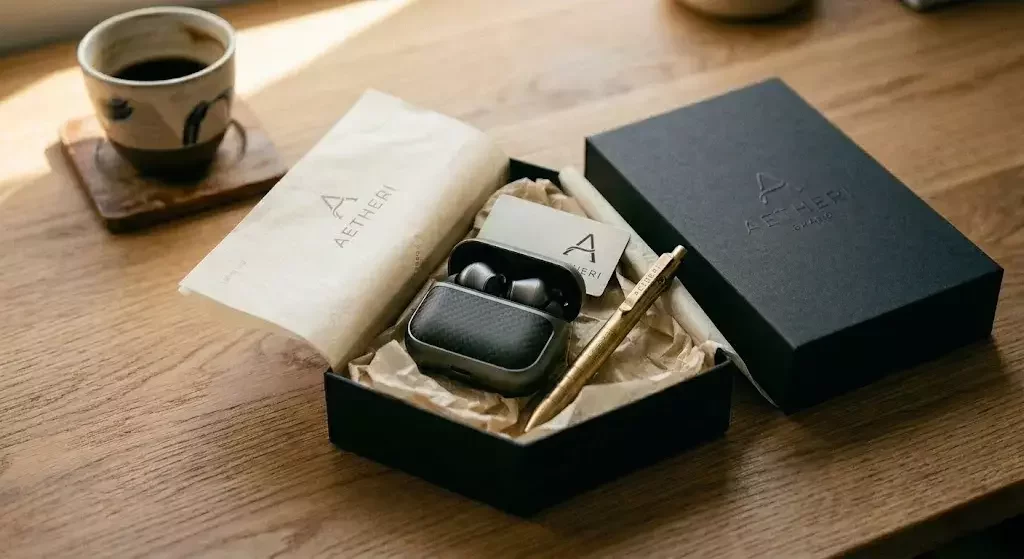
to burn. Intentional, curated physical branded merchandise designed to create a memory that no algorithm can erase.
There is a marketing channel that cannot be scrolled past, blocked by an ad blocker, skipped with a button, or muted. It doesn’t require a platform, a CPM bid, or a creative refresh every six days. And most brand leaders have been systematically underinvesting in it for a decade while paying record prices for digital inventory that nobody remembers.
You Can’t Scroll Past Something You’re Holding
There’s a belief that runs through almost every marketing department in the country: if you can measure it, it’s working. If you can’t measure it, it’s a risk.
This belief has made digital the default channel for brand investment, and it has made the CMO’s job easier in exactly one way. The dashboard always has an answer. Impressions. Clicks. Open rates. Engagement rate. Every metric has a number justifies the next quarter’s spend.
The problem is that measurability has become a proxy for effectiveness. Those two things are not the same.
Digital marketing is extraordinarily good at generating data. It is increasingly poor at generating the emotional brand impression that lasts.
Seth Godin put it plainly in This Is Marketing: “The thing you sell is simply a road to achieve those emotions, and we let everyone down when we focus on the tactics, not the outcomes.”
The tactic is the ad. The outcome is the memory. And the memory is where brands actually live.
A digital ad, even a well-targeted, well-designed, well-placed one, holds human attention for an average of 1.7 seconds. That’s not a knock on digital. That’s just physics. Human beings have finite attention, and screens have trained them to distribute it in smaller and smaller increments.
A physical object on someone’s desk? It occupies their peripheral vision for hours a day. For months. Sometimes years. Every time they reach for their coffee. Every time they look up from their laptop. Every time someone in a meeting says “what’s that?” Your brand is there. Present. Tactile. Real.
The impression-per-dollar, when you run it honestly, is not close.
A company running a targeted LinkedIn campaign reaches 5,000 decision-makers in their category. Cost is real, tracking is solid, data looks decent. Meanwhile, a competitor sends a curated physical package, something genuinely beautiful and genuinely specific to the recipient, to 50 of those same decision-makers. The LinkedIn campaign generates some clicks and a modest number of form fills. The physical touchpoints generate inbound calls, unprompted social posts, and referrals to colleagues.
Which one built more pipeline? Which one built more brand?
It’s not nostalgia for print. It’s not a rejection of digital. It’s an argument about scarcity. Digital attention is abundant. There is more of it than any of us know what to do with. Physical attention, the kind that comes from holding something in your hands and knowing someone thought about you specifically, is genuinely scarce.
Scarce things have leverage. Every first-year economics student knows this.
The brands treating branded merchandise as a serious channel, not an afterthought and not a budget line no one fights for, are operating with an advantage their competitors don’t see coming. Because their competitors are busy refreshing the dashboard, watching the click-through rate, and wondering why their brand feels like it’s treading water.
I don’t think digital marketing is the villain.
I think the villain is the unchallenged assumption that digital is automatically the best use of every dollar because it’s the easiest to justify in a spreadsheet.
That assumption has cost brands more than anyone is willing to admit.
How To Build A Physical Brand Presence That Digital Can’t Touch
Memory is not a digital phenomenon.
It’s formed through sensory experience. Smell, touch, taste, sight, sound. Screens deliver two of the five. Branded merch delivers all of them. It’s a biological fact, and I’d argue it’s the most underused piece of marketing intelligence in the room.
The reason most brands haven’t cracked the physical channel isn’t budget. It’s thinking. They look for digital logic in a physical medium. Volume over intent, impressions over impact, speed over craft. They order 500 branded notebooks from a catalog. They ship them to a list. They call it done.
That’s not a physical brand story. That’s a different version of the same problem.
The following five steps are sequenced intentionally. Each one builds on the last.
Step 1: Identify Your Top 50
Physical doesn’t need to scale. That’s the first thing to let go of.
Digital thinking demands scale. More is always better. Reach more people, generate more impressions, cast the widest possible net.
Physical thinking demands intention. The entire point is that it feels specific, personal, and considered. You cannot fake that at 50,000 units.
Identify the 50 relationships in your world where a single intentional physical touchpoint could move the needle more than six months of email nurture. Your top prospects. The referral sources you haven’t properly thanked. The client relationships that need reinvesting. The strategic partners who would send you business if they felt more seen.
The brands that treat their Top 50 list like the asset it is stop chasing attention and start owning it.
Step 2: Design For The Desk, Not The Moment
Most branded merchandise is designed to impress on delivery day. The unboxing moment. The “ooh, that’s nice” from whoever opens the package.
That is the wrong design brief.
The goal is not to impress on day one. The goal is to earn a permanent place in someone’s daily life. Their desk. Their bag. Their kitchen counter. Somewhere that delivers passive, ongoing brand exposure for months without requiring anyone to click anything.
Where will this live in six months? If the honest answer is “in a drawer” or “in the trash,” it’s the wrong item. The item that earns a permanent place on someone’s desk is the one doing the marketing. Everything else is a memory of money spent.
I’ve spent close 25 years watching this play out across thousands of programs. The items people keep are never the ones that cost the most. They’re the ones that felt most considered. Thoughtfulness is the design principle. Everything else is a spec sheet.
Step 3: Make It Unreasonably Specific
This is where most brands pull back toward safe. They get close to specific, then default to something broadly appropriate.
They choose a quality item, brand it well, send it to a thoughtfully chosen list. That’s good. But good isn’t what generates the response you’re after.
The branded merch that get photographed and posted, that get mentioned in meetings, that get walked over to a colleague’s desk feel tailored. The recipient looks at it and thinks: how did they know?
That level of specificity cannot be replicated by any digital channel at any price. An algorithm can show someone an ad that matches their browsing behavior. It cannot send them something that reflects their specific personality, their industry context, their aesthetic preference, and the conversation you had six months ago that stuck with you.
This is the gap. It is real. It is growing. And most brands are leaving it completely untouched.
Step 4: Engineer The Trigger
Branded merchandise sent without context is just a package. The trigger is what transforms it into a signal.
Every intentional physical brand expression should be tied to something that makes the item feel earned rather than random. A prospect who just announced a new funding round. A client who hit a milestone. A partner who sent you a referral for the first time. An anniversary. A shared industry moment. A win worth acknowledging.
The trigger elevates the item from “gift” to “we were paying attention.” It says: we noticed. We thought of you specifically, at this specific moment. That is categorically different from a holiday gift sent to a list on November 15th because that’s when someone remembered to order it.
Step 5: Create A Reason To Respond
The best branded merchandise doesn’t end the conversation. They open one.
Build in a natural response mechanism. A handwritten note that asks a genuine question. A card that invites a call. Something that creates a natural next step. Not a sales pitch in disguise, not a QR code pointing to a landing page, but a real reason to reply. A thread to pull.
The physical item gets you in the room. The response mechanism keeps you there.
THE CRAFTED TAKEAWAY
Digital marketing will tell you how many people saw you. Branded merchandise will determine how many people remember you. The channel that cannot be scrolled past, skipped, or blocked is the one most brand leaders have quietly written off as a line item. The brands that see it first will own the relationships that matter most.
Before your next marketing planning meeting, pull up your budget and ask one question: how much of this can someone hold in their hands? Whatever that number is, it’s probably too low. Reply if you think I’m wrong.