
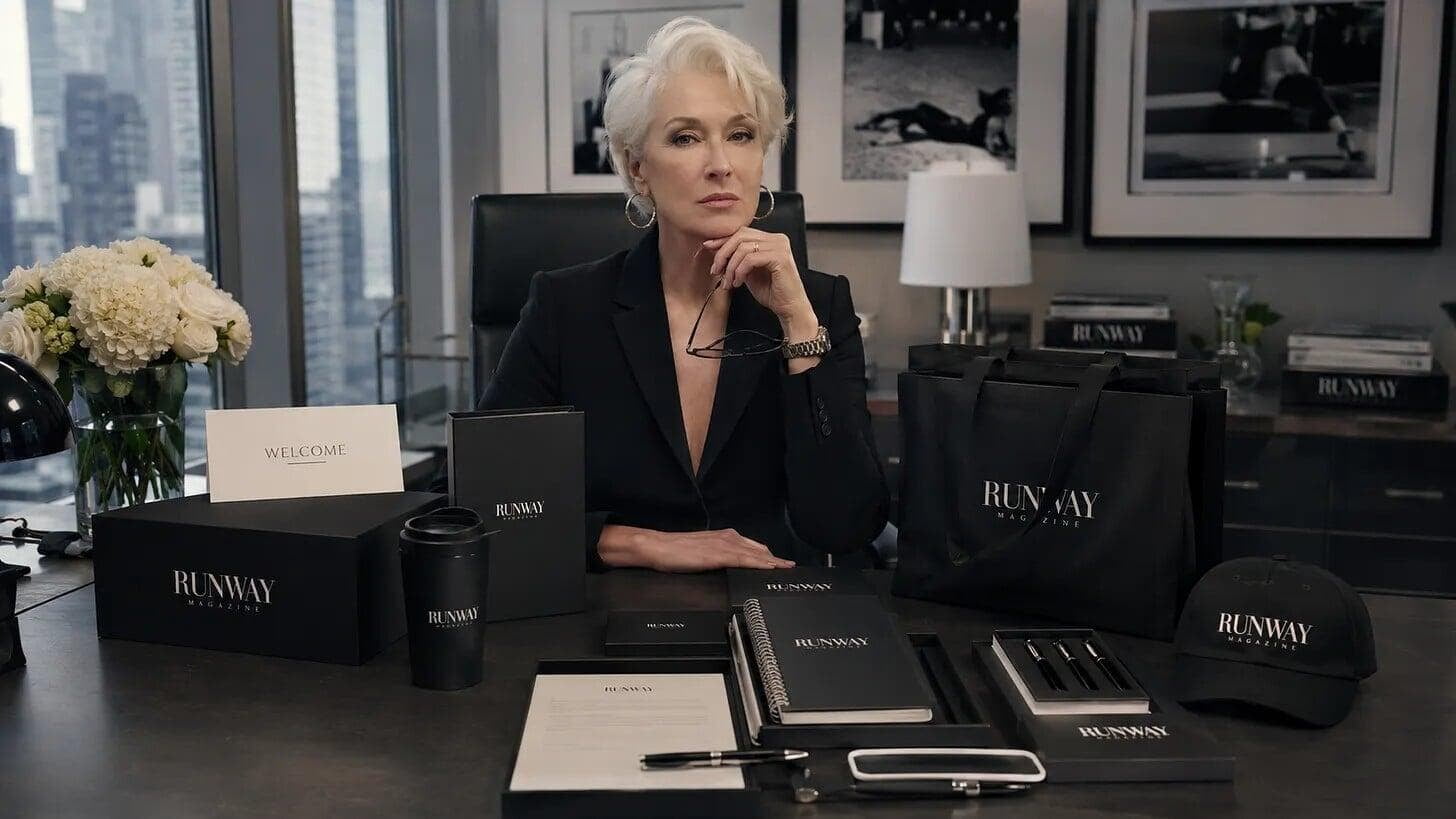
Miranda Priestly didn’t run ads.
She built one of the most recognizable brands in fiction through a single, relentless standard. Nothing in her world was incidental. The clothes. The office. The way the coffee arrived. Every detail said the same thing.
The Devil Wears Prada 2 just hit theaters. Twenty years after the original, Miranda is still the benchmark. Not because the story is about fashion. Because it’s about what happens when someone refuses to let a single touchpoint slip below the standard.
Firms holding clients for 20, 30 years aren’t winning on price. They’re not even winning purely on outcomes. The firms that keep clients for decades are winning on the cumulative weight of every detail that said we take this seriously.
Most firms never think about that weight.
They think about the retainer. The kickoff call. The engagement letter. And then, somewhere in the onboarding checklist, someone orders a welcome kit. A pen with the logo. A notepad. Maybe a tote bag. It arrives in a brown box with a packing slip.
Nobody thought twice about it.
Your welcome kit is not a formality. It is the first piece of physical evidence that your brand promise is real. Before the client has any reason to trust you beyond what you told them in the pitch, something physical arrived at their office.
And it said something.
The question is whether you know what it said.
The Priestly Problem
There’s a scene early in the original Devil Wears Prada where Andy shows up to her first day wearing a lumpy blue sweater. She thinks it’s fine. Miranda dismantles her in eleven seconds.
The sweater wasn’t just a sweater. It was evidence.
That’s how your clients read your welcome kit. Not consciously. They’re not sitting there with a rubric. But they feel it. The weight of the materials. The cohesion of the objects. Whether the whole thing feels considered or cobbled together. They form a conclusion before they’ve read a word.
Most firms treat the welcome kit as a logistics exercise. The thinking, when there is any thinking, goes like this: we need to send something, so let’s send something professional.
The result is a sea of sameness.
Walk into any mid-size firm’s supply closet and you’ll find the same things. Pens from a catalog. Notepads with the firm name embossed on the cover. A brochure that was designed four years ago and reprinted twice since. Maybe a coffee mug. Maybe a tote.
It’s not offensive. It’s not embarrassing. It’s just...nothing.
Every piece of merch you send a client either builds trust or quietly erodes it. The welcome kit that feels generic doesn’t just fail to impress. It creates a small but real gap between what you promised in the pitch and what arrived at their door.
I’ve seen it happen. A firm spends months pursuing a relationship. The pitch is sharp. The partners are impressive. The engagement letter is airtight. And then a brown box shows up with a pen that stops working in two weeks and a notepad the client uses to write grocery lists.
The client doesn’t cancel the engagement. But something shifted. A small voice inside their head says: maybe they’re not quite as buttoned-up as they seemed.
Now flip it.
A firm I worked with decided to rethink their onboarding kit from scratch. Not the budget. The brief. They started by asking what do we want this client to feel when they open this box?
The answer drove everything. The materials. The sequence. The note tucked inside that was specific to that client’s situation, not a mail-merged template. When the box arrived, the client called the partner directly. Not to discuss the matter. To say the kit was the most thoughtful thing any firm had ever sent them.
That client is still with the firm seven years later.
That’s what a welcome kit can do when someone treats it like a brand decision.
I use the Brand Story Litmus Test to evaluate a firm’s kit. Three questions. Simple. Brutal.
If you removed the logo, would the quality of the merch still communicate your brand?
Does every item in the kit tell the same story you told in the pitch?
Would you be proud to have Miranda Priestly open this box?
Most firms can’t get past question one.
The Touchpoint Playbook
Miranda Priestly didn’t have a checklist. She had a standard.
Most firms don’t need a bigger budget to fix their welcome kit. They need a clearer brief. The difference between a kit that builds loyalty and one that disappears into a desk drawer isn’t money. It’s intention.
1. Run the Brand Story Litmus Test
This matters because most kits are assembled backwards. Someone picks the objects first, then slaps a logo on them, then calls it done.
The Brand Story Litmus Test forces you to start with the story and let the objects follow. If a pen doesn’t pass the test, no logo saves it. If a notebook doesn’t feel like your firm, it doesn’t belong in the box.
The clarity the test creates saves you from years of sending the wrong thing.
2. Audit the Unboxing Sequence
There are four beats to every physical brand experience. Anticipation. Discovery. Reveal. Reaction.
Anticipation is what the client feels before they open anything. Does the exterior of the package signal that something worth opening is inside? Or does it look like every other delivery they got that day?
Discovery is the moment they lift the lid. What do they see first? Is there a logical, considered order to what they encounter?
Reveal is the individual objects. Each one should earn its place. Each one should feel intentional.
Reaction is what they do after. Do they put it on their desk? Call someone? Take a photo? Or does it go straight into a cabinet?
Walk your current kit through all four beats. Most firms have never done this. The gaps will be obvious.
3. Eliminate the Catalog Default
This is the hardest habit to break.
The catalog default feels efficient. Your current supplier has options. They’re easy to order. They arrive on time. Nobody complains.
But the catalog is built for volume, not story. Every object in it exists to appeal to the widest possible audience. That’s the opposite of what a brand decision requires.
Start with the story. What does your firm stand for? What do you want this client to feel? What objects, materials, and details communicate that? Then go find those things. It takes longer. It costs more thought, if not always more money. And it produces a kit that feels like it was made for this firm, not assembled for any firm…something a catalog never can.
4. Build for the 10-Year Client
When you’re designing your welcome kit, don’t think about the new client in front of you. Think about what that client looks like in ten years.
Now ask: what would you put in a box for that person?
The answer raises the standard immediately. You stop thinking about what’s adequate and start thinking about what’s worthy. You stop sourcing for the transaction and start sourcing for the relationship.
Build that kit. Send it on day one.
5. Set a Physical Brand Standard
Miranda Priestly’s team didn’t guess what she wanted. They knew. Because the standard was clear, consistent, and non-negotiable.
Your firm needs the same thing for every client-facing physical touchpoint.
One document. One page. It defines the quality level, the aesthetic direction, and the narrative your objects need to communicate. It answers the question before anyone has to ask it. It makes the next kit easier to build and harder to get wrong.
This isn’t a style guide. It’s a brand decision made in advance so it doesn’t get made under pressure, by whoever happens to be handling the order that week.
If a prospective client opened your welcome kit without knowing anything about your firm, what conclusion would they draw?
Is that the conclusion you want them to reach?