
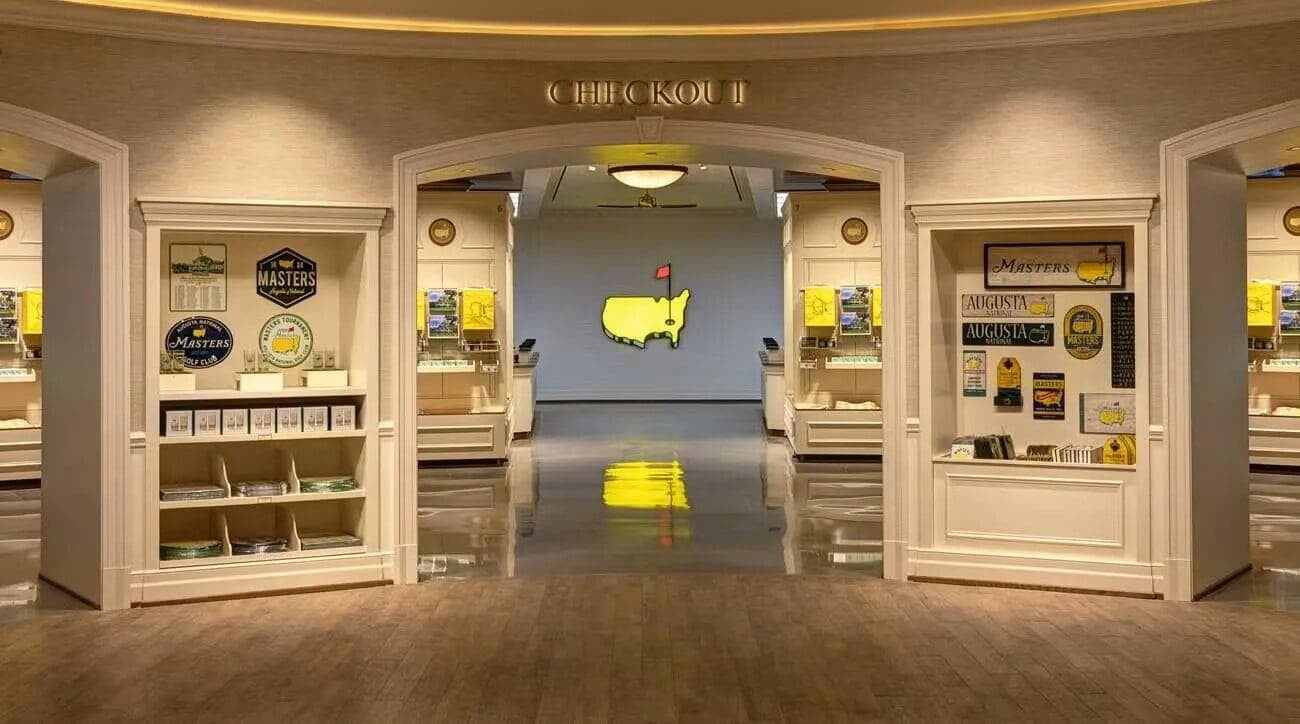
TL;DR: Augusta National has never bought an ad. Their merchandise tent generates an estimated $70M in a single week because the standards never slip. The lesson for your brand: restraint is a strategy, and the quieter you get, the more people lean in.
Augusta National has never bought a Super Bowl ad.
No billboards. No retargeting campaigns. No influencer partnerships. The most watched golf tournament on earth runs on almost no traditional marketing, and it has been doing so for nearly a century.
Yet the green jacket is the most recognized symbol in golf.
The merchandise shop at Augusta generates an estimated $70 million or more in a single week. People wait in lines that stretch past reason. They buy hats, shirts, and flags. Items you can find in any sporting goods store. They treat them like artifacts.
Because at Augusta National, the standards never slip.
The grass is cut to a specific height. The azaleas bloom on schedule. There is a code at Augusta National, and it runs through every detail of the experience. You feel it the moment you walk through the gates.
Most brand leaders do the opposite. When the brief says “increase brand visibility,” the instinct is volume. More items. More logos. More impressions. The assumption is that visibility equals value.
Augusta figured out something different a long time ago. Restraint functions as a complete brand strategy. Ninety years of evidence supports it.
Most companies ask: what merch should we order? Augusta National asks: what would someone keep, display, and talk about?
That question changes everything.
The Loudest Brands in The Room Are Usually the Weakest
There is a particular kind of event most brand managers have attended. A conference. A client appreciation day. A company milestone. Someone pulls up a spreadsheet from a catalog, picks twelve items, adds a logo to each, and ships three hundred units to the venue.
The result is a table covered in objects that don’t communicate anything about the company’s brand story.
This is the volume trap. More items means more exposure. More impressions. More people walking away with something that has your name on it. The math seems to work until you ask where those items are six weeks later.
Most of them are in a landfill.
The volume approach treats branded merchandise as a media buy. Impressions are the currency. But impressions are not the same as memory. Memory is the only currency that actually builds a brand.
Augusta National understands this at a structural level.
Think about the green jacket. It is not for sale. You cannot buy one in the pro shop. You cannot order one online. The only way to own a green jacket is to win The Masters or gain membership (good luck with both).
The scarcity is not accidental. The scarcity is the point.
This is The Masters Effect. When standards hold and access is thoughtfully controlled, desire compounds. The merch becomes a signal. The signal becomes a story. The story becomes the brand.
Consider how this plays out at a law firm. A marketing director at a 200-person firm is planning a client appreciation program. She has a budget. She has a timeline. She picks eight items from a catalog. Adds the logo. Ships them out.
Her clients receive the package. They recognize the logo. They appreciate the gesture. They put the tote bag in a closet and forget about it within a month.
Now imagine she took a different approach. She chose one item. A single, well-made, thoughtfully sourced object that reflected something specific about her firm’s story. She packaged it with intention. She wrote a note that connected the item to a shared moment with the client. She sent fewer, to the relationships that mattered most.
Her clients received the package. They felt the weight of it before they opened it. They noticed the packaging. They found the note. The item stayed on a desk where clients could see it.
Same budget. Different philosophy. Completely different outcome.
That is The Masters Effect applied to branded merchandise.
Most brand leaders miss that restraint signals confidence. Volume signals insecurity. When you send everything, you are implying you are not sure what works. When you send one precise, intentional thing, you are telling the recipient you know exactly who they are and what they value.
Augusta does not try to appeal to everyone. Augusta holds its standards and lets the right people find them.
How To Apply the Masters Effect to Your Physical Brand Expressions
Seth Godin wrote in This Is Marketing (2018): “The goal is not to find customers for your products. The goal is to find products for your customers.”
Most merch programs have this sequence backwards. They start with a catalog and work toward a recipient. The Masters Effect flips it. Start with the recipient and work backward to the object.
Step 1: Run The Patron Audit
Augusta calls their attendees “patrons.” Not fans. Not spectators. Patrons. The word signals that these are people whose presence is valued, not merely counted.
Before you order a single item, ask would a patron keep this, display this, or talk about this?
Appreciation is too low a bar. The question is whether the item earns a permanent place in someone’s life. If the honest answer is no, the item does not belong in your program.
Go through your current mix item by item. Anything that fails the Patron Audit gets cut. This exercise alone will likely reduce your item count by half. That is the beginning of the strategy, not the problem with it.
Step 2: Cut The Catalog in Half
This is the step most brand leaders resist. The instinct is that fewer items means less coverage. Less coverage means missed opportunities.
The instinct is wrong.
When you send ten items, each one carries one-tenth of the attention. When you send one, it carries everything. Augusta National does not offer forty souvenirs designed for forty different buyer profiles. They offer a focused selection, executed with consistent standards, and the line stretches around the block anyway.
Fewer items, done well, communicate standards. A long list of items, done adequately, communicates volume.
Your recipients can feel the difference.
Start by identifying the three items in your current mix that perform best on retention. The items people actually keep and use. Build around those. Let the rest go.
Step 3: Apply The Green Jacket Test
The green jacket is irreplaceable because it could only come from Augusta National. You cannot find its equivalent anywhere else. It belongs entirely to that brand.
For every item you consider, ask: could this come from any other company, or could it only come from ours?
If the answer is any other company, it fails the test. A generic pen with your logo on it could come from anyone. A meticulously crafted notebook with your brand’s story printed inside the cover, in the voice your clients already recognize, is yours.
The Green Jacket Test is a filter for brand specificity. Items that pass it carry your story. Items that fail it carry only your logo. Those are two very different things.
Step 4: Control Distribution
Augusta National controls who gets in. The ticket waiting list is decades long. Access is managed, deliberate, and treated as a privilege.
You can apply the same principle without turning your merch program into an exclusive club. The key is intentionality about who receives what, and when.
A welcome kit sent to a new client on day one carries more weight than a year-end box sent to everyone. A personally addressed gift tied to a specific milestone communicates something a mass shipment cannot.
When you control distribution with that level of care, the item arrives already carrying meaning before the recipient opens it.
Step 5: Let the Object Tell the Story
Augusta does not put signage everywhere explaining why The Masters is special. They let the experience speak. The course. The silence. The ritual. The jacket.
I call the experience mechanism the four-beat unboxing framework: Anticipation, Discovery, Reveal, Reaction. Each beat is a deliberate choice. The packaging creates anticipation before the item is seen. The reveal lands because the presentation was earned. The reaction is the memory the recipient carries forward.
That memory is the brand.
When a client receives branded merchandise from your company and says “this feels like you,” you have applied The Masters Effect. The object carries the story. The story carries the brand. The brand builds the relationship.
That is what branded merchandise is supposed to do. Build a story someone wants to be part of.
THE CRAFTED TAKEAWAY
Restraint is a brand decision. A budget follows from it. The brands that get remembered are not the ones that sent the most items. They are the ones that sent the right item, at the right moment, to the right person. Augusta National built the most recognized brand in golf on that principle alone. Your physical brand expressions can work the same way. Fewer. Better. More intentional. That is The Masters Effect.
What’s one item in your current merch mix that would fail the Patron Audit?